TL;DR – AI search is eating clicks, so traffic is down everywhere, but SEO still works if your brand shows up in AI answers, maintains rankings and impressions, attracts engaged visitors, and keeps driving leads and revenue.
Google AI Mode and AI Overviews are reshaping what search success looks like. Here is how to measure what actually matters now.
If your organic traffic numbers are down this year, you are not alone, and you are probably not doing anything wrong.
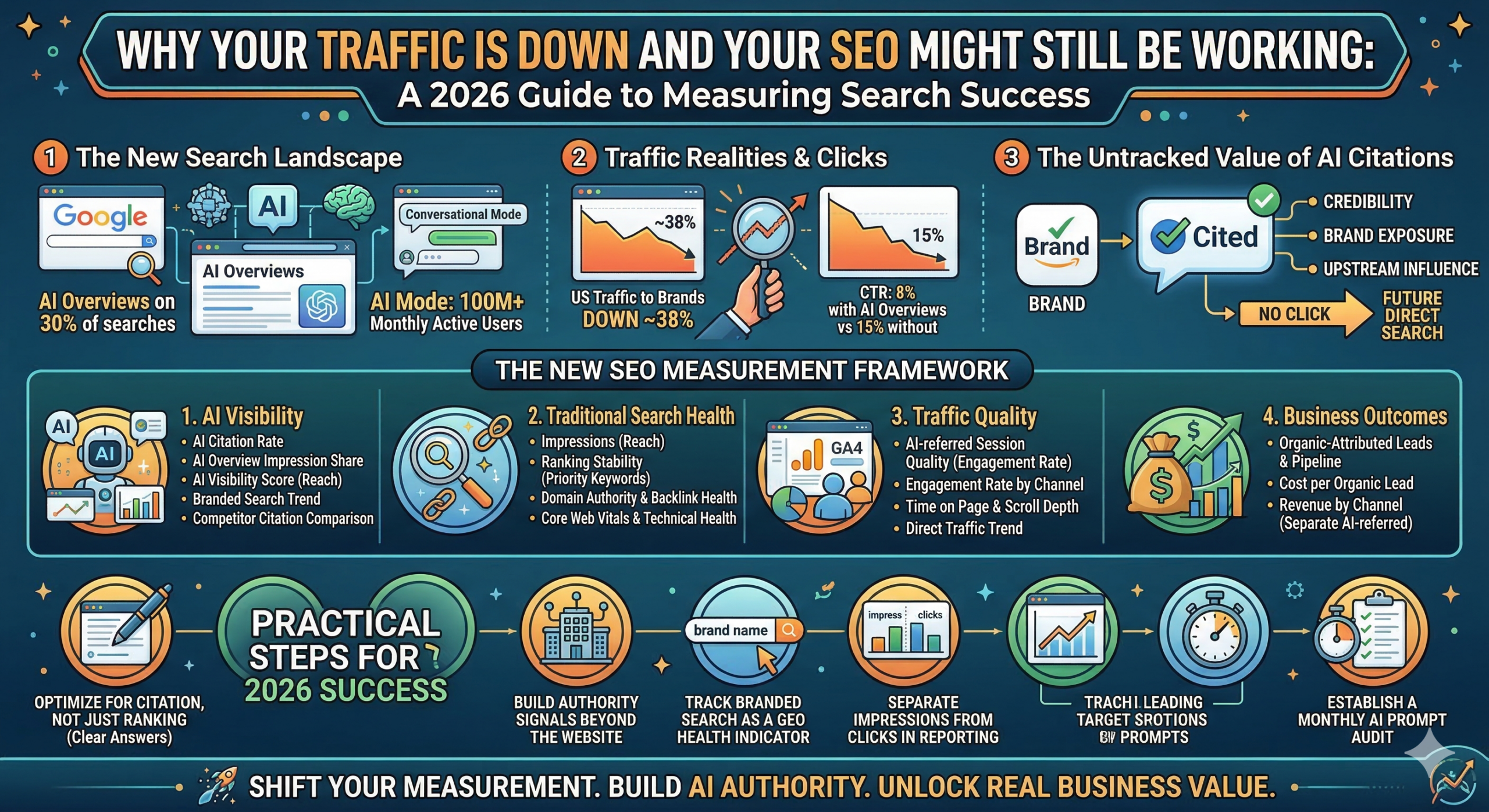
Google search traffic to publisher and brand websites declined globally by roughly a third in the year to November 2025, according to Chartbeat data covering more than 2,500 sites. For US-based properties, the drop was closer to 38%. And the cause is not a penalty, an algorithm shift, or a technical problem on your site. It is a structural change in how Google delivers answers to people.
AI Overviews now appear on roughly 30% of US desktop searches. AI Mode, Google’s deeper conversational search experience, has 100 million monthly active users in the US and India alone. When these features appear, users increasingly get what they need without having to click through to any website. A Pew Research study tracking 68,000 real queries found that users clicked on results only 8% of the time when AI summaries appeared, compared to 15% without them.
The traffic just is not coming through the way it used to.
But here is what gets lost in the conversation about declining traffic: the work you are doing on SEO and GEO may be delivering real business value that your current reporting framework cannot see. This post is about fixing that.
What Is Actually Happening in Search Right Now
To understand why traffic metrics are misleading, it helps to understand the mechanics of what changed.
When Google’s AI Overviews answer a question, they pull from sources they deem authoritative and trustworthy. The brands and sites that are cited in those summaries gain visibility and credibility with readers, even when no click occurs. Research from Seer Interactive found that brands cited inside AI Overviews earn 35% more organic clicks and 91% more paid clicks than non-cited brands on the same queries. The citation is doing work.
The same dynamic applies across AI Mode, ChatGPT, Perplexity, Gemini, and every other AI-powered discovery surface. Users are forming impressions of brands through AI-generated answers before they ever visit a website. Around 80% of B2B technology buyers now say they trust generative AI as much as traditional search engines when researching suppliers. The influence is happening upstream of the click.
This creates a measurement problem. If you are only tracking sessions, pageviews, and keyword rankings, you are measuring the output of the old search model. You are flying blind on the new one.
That last number deserves attention. AI-referred traffic converts at 23 times the rate of standard organic traffic. The visits you are getting from AI search are extraordinarily qualified. Traffic is down, but the traffic that is coming through is better than ever. Your reporting needs to reflect that.
61% drop in organic CTR when AI Overviews appear (Seer Interactive, 2025)
35% more organic clicks earned by brands cited inside AI Overviews vs. non-cited brands
93% of AI Mode searches end without a click to any website (Semrush, 2025)
23x higher conversion rate from AI-referred visitors vs. traditional organic search (Ahrefs, 2025)

The Measurement Framework We Use With Our Clients
At Enilon, we have updated our reporting framework to reflect how search actually works in 2026. Rather than leading with sessions and rankings, we now organize reporting around four categories: AI visibility, traditional search health, traffic quality, and business outcomes. All four matter. None tells the full story alone.
Category 1: AI Visibility Metrics
These metrics tell you whether your brand is present and credible in AI-generated answers, regardless of whether any clicks occur.
| Metric | How to Measure It | Why It Matters |
|---|---|---|
| AI citation rate | Run a defined set of target queries monthly in Google AI Overviews, ChatGPT, Perplexity, and Gemini. Record how often your brand or content is cited. | This is your share of voice in AI search. Rising citation rate means the content and authority work is paying off. |
| AI Overview impression share | Track what percentage of tested prompts return your brand in the response. Tools like Conductor, Profound, or manual prompt tracking. | Shows overall AI presence across platforms. A flat or growing score while organic traffic declines means your GEO work is working. |
| AI visibility score | This is your share of voice in AI search. A rising citation rate means the content and authority work are paying off. | Impressions without clicks still represent brand exposure to high-intent users. This number tells the real reach story. |
| Branded search volume trend | Google Search Console and Google Trends. Track branded queries month over month. | Users who encounter your brand in an AI answer often search your name directly later. Rising branded search is a downstream signal of AI visibility. |
| Competitor citation comparison | Run the same prompts for your top competitors. Track share of mentions. | Absolute citation rate matters less than relative position. Are you winning more AI mentions than competitors on your most important queries? |
Category 2: Traditional Search Health
Organic traffic is not the right primary metric anymore, but traditional search health still matters. These signals tell you whether the foundational work is sound.
| Metric | How to Measure It | Why It Matters |
|---|---|---|
| Impressions (not just clicks) | Google Search Console. Track impressions alongside clicks and separate the two in reporting. | Impressions measure reach. If impressions are stable or growing while clicks decline, the content is ranking but AI Overviews are absorbing the clicks. That is different from a rankings problem. |
| Ranking stability for priority keywords | Semrush, Ahrefs, or similar tools. Focus on the keywords that matter commercially, not total keyword count. | You want to know whether you are holding your positions. Loss of ranking is a content or authority problem. Loss of CTR at stable rankings is an AI Overviews problem. |
| Domain authority and backlink health | You want to know whether you are holding your positions. A loss of ranking is a content or authority issue. Loss of CTR at stable rankings is an AI Overviews problem. | Domain authority is the strongest predictor of AI citation likelihood. Sites with over 32,000 referring domains are 3.5x more likely to be cited by ChatGPT than low-authority sites. |
| Core Web Vitals and technical health | Google Search Console, PageSpeed Insights. Monitor on a monthly cadence. | Technical health is table stakes for both traditional rankings and AI crawlability. Content that loads poorly or has structural issues is less likely to be indexed as a trusted source. |
Category 3: Traffic Quality Metrics
Since the volume of organic traffic is declining industry-wide, the quality of the traffic you do receive becomes a more meaningful signal. These metrics tell you whether the visitors arriving are actually worth having.
| Metric | How to Measure It | Why It Matters |
|---|---|---|
| AI-referred session quality | GA4 engagement rate (sessions over 10 seconds with interaction). Compare SEO, GEO-referred, direct, and paid. | Engagement rate is a better proxy for content quality and audience match than raw sessions. Falling traffic with rising engagement is a positive signal. |
| Engagement rate by channel | GA4 scroll event tracking and average engagement time by landing page. | Engagement rate is a better proxy for content quality and audience match than raw sessions. Falling traffic with rising engagement is a positive signal. |
| Time on page and scroll depth | GA4 scroll event tracking and average engagement time by landing page. | Users who arrive from AI-assisted discovery tend to be further along in their research. Deeper engagement suggests your content is satisfying high-intent queries. |
| Direct traffic trend | GA4 channel grouping. Track direct traffic month over month alongside branded search. | Direct traffic often rises as a lagged effect of AI visibility. Users encounter your brand in an AI answer, then type your URL directly. A rising direct traffic trend is a GEO success signal. |
Category 4: Business Outcome Metrics
Ultimately, the only metrics that matter are the ones tied to revenue and pipeline. These keep everything else honest.
| Metric | How to Measure It | Why It Matters |
|---|---|---|
| Organic-attributed leads and pipeline | CRM attribution. Track leads where the first or last touch was organic search or AI-referred traffic. | If organic and AI channels are generating a qualified pipeline, traffic volume becomes a secondary concern. Pipeline tells the real story. |
Cost per organic lead | Total SEO/GEO investment divided by organic-attributed leads. Track monthly. | Engagement rate is a better proxy for content quality and audience match than raw sessions. Falling traffic with rising engagement is a positive signal. |
| Revenue by channel | GA4 e-commerce reporting or CRM revenue attribution. Separate organic, AI-referred, direct, and branded. | Users who arrive from AI-assisted discovery tend to be further along in their research. Deeper engagement suggests your content is satisfying high-intent queries. |
“The question is not whether your traffic is down. It probably is. The question is whether your brand is present in the conversations your buyers are having with AI before they ever visit any website. That is the new first page of search.”
What Enilon Reports on Now
We have retired traffic as a headline metric in our SEO and GEO reporting. It is still tracked and in the data, but it no longer leads the story.
Our monthly reporting for SEO and GEO clients now opens with AI visibility: how often the brand is appearing in AI-generated answers for priority queries, how that compares to the prior period, and how it compares to key competitors. We follow that with impression data from Search Console, which shows true reach even when clicks do not follow. Then we look at the quality of the traffic that does arrive, conversion rates from AI-referred sessions, and the downstream pipeline.
This framework does a better job of answering the questions that actually matter. Is the brand more visible to buyers who are researching? Is the content being recognized as authoritative by AI systems? Is the traffic arriving better qualified than it was before? Are leads and pipeline holding up?
Traffic is one input into those answers. It is not the answer itself.
The Practical Steps We Take With Clients
Optimize for citation, not just ranking
Content that earns AI citations tends to share certain characteristics: it leads with a clear, direct answer in the first paragraph, uses specific data and named sources, employs definite language rather than vague qualifiers, and covers topics with enough depth that AI systems treat it as a reference rather than a surface-level result. We restructure existing content around these principles before creating anything new.
Build authority signals beyond the website
Domain authority is the strongest predictor of AI citation likelihood. We work with clients to expand their presence on platforms AI systems consider credible: industry publications, third-party review sites like G2 and Capterra, active participation in forums like Reddit and Quora, and earned media coverage. These off-site signals build the trust that leads to a brand being cited in AI answers.
Track branded search as a GEO health indicator
Every month we look at whether branded search volume is growing. Users who encounter a brand in an AI answer frequently search for it by name later. Rising branded query volume is one of the clearest signals that AI visibility work is generating real awareness, even when direct click attribution is not available.
Separate impressions from clicks in reporting
We pull Google Search Console data, with impressions and clicks tracked separately and mapped to the queries triggering AI Overviews. A page holding position one with stable impressions but declining CTR is performing well in an AI Overview environment. That is a different situation from a page losing impressions, and it calls for a different response.
Establish a monthly AI prompt audit
We run a structured set of 20 to 40 target queries across Google AI Overviews, ChatGPT, Perplexity, and Gemini every month and record whether the client is cited, how prominently, and what competitors appear alongside them. This takes about two hours and produces one of the most useful data points in our reporting.
The Bottom Line
Traffic is not the right metric for evaluating SEO and GEO in 2026. It never perfectly measured what those channels were doing for a business, and the rise of AI-powered search has widened the gap between traffic and value more than ever.
The brands that will succeed in this environment are the ones that become the sources AI systems trust. That means strong domain authority, content built for citation quality rather than keyword volume, and active presence on the platforms that signal credibility to AI.
If you are measuring your SEO program solely by sessions and rankings, you are missing most of the picture. And if your traffic is down but your AI citation rate is growing, your branded search is rising, and your organic-attributed pipeline is holding steady, your program is working. You just need a reporting framework that shows it.
We can help with both.
Want to see what your brand’s AI visibility actually looks like?
We will run an AI citation audit across your priority queries and show you exactly where you stand versus your competitors. Talk to an Enilon strategist today.
FAQ
What does it mean if my website traffic is down but rankings are stable?
If your rankings and impressions are stable but traffic is declining, AI Overviews and zero-click results are likely absorbing clicks. Your SEO is still working, but users are getting answers directly in search instead of visiting your site.
How do AI Overviews affect organic traffic?
AI Overviews reduce organic click-through rates by answering questions directly in search results. This means fewer users click through to websites, even when your content is ranking well or being cited.
What is AI visibility in SEO?
AI visibility refers to how often your brand or content is cited in AI-generated answers across platforms like Google AI Overviews, ChatGPT, and Perplexity. It measures your presence in AI search, not just traditional rankings.
Why is SEO still valuable if fewer people are clicking?
SEO still builds authority and influences buying decisions. Even without clicks, being cited in AI answers increases brand awareness, trust, and can drive higher-quality traffic later in the user journey.
What metrics should replace traffic as the main SEO KPI?
Instead of focusing only on traffic, track AI citation rate, search impressions, engagement rate, branded search growth, and conversions. These metrics better reflect performance in AI-driven search environments.

Claire Brunner has been in the digital marketing space for over 20 years. Driving customer growth strategies for businesses in industries spanning technology, manufacturing, retail, luxury, fashion and home services. She’s based in Phoenix, AZ, part owner of Enilon where she leads Client Strategy, Marketing and Business Development.