TLDR: – Your brand isn’t showing up in AI search because AI doesn’t clearly understand, trust, or recognize you. To improve visibility, you need to strengthen your brand signals, clean up inconsistent information across the web, create genuinely useful content, build authority through external mentions, and organize your site structure so your expertise is clear.
You’ve got content. You’ve invested in SEO. Maybe you even read a few articles about optimizing for AI search. And yet… when you ask ChatGPT, Perplexity, or Google’s AI results about your space, your brand is nowhere to be found.
Not mentioned. Not cited. Not even close.
Frustrating, right?
You’re not alone. I’ve had this exact conversation with a few clients over the past couple of months. One of them pulled up ChatGPT during a call and said, “Look… we’re not even in here.” You could hear the disappointment.
So what’s going on?
Here’s the thing. AI search doesn’t work like traditional SEO. It’s not just about rankings anymore. It’s about whether the model understands who you are, trusts your content, and sees enough signals across the web to include you in an answer.
And if even one of those pieces is missing, you’re invisible.
Let’s walk through the most common reasons this happens and, more importantly, how to fix it.

1. Your Brand Has Weak Entity Signals (AI Doesn’t Know “Who You Are”)
This is the big one. And honestly, it’s where most brands fall short.
Search engines used to focus on keywords. AI systems focus on entities. That just means they’re trying to understand real-world things like companies, people, products, and how they connect.
If your brand isn’t clearly defined across the web, AI struggles to “recognize” you.
Common entity signal problems
- Your brand name shows up differently across pages
- No clear “About” page or company description
- No consistent positioning (are you an agency? a platform? a service?)
- Limited mentions outside your own website
- No structured data helps define your business
Think of it like this. If someone introduced you to five different people and each one described you differently, it would be confusing, right?
That’s exactly what AI is dealing with.
How to fix this:
Start with clarity.
- Define your brand in one simple sentence and use it consistently
- Create a strong About page that clearly explains what you do
- Add structured data (Organization schema) so machines can understand you
- Make sure your brand name, description, and services are consistent everywhere
And this part matters more than people think…
You need external validation. That means mentions on other websites, not just your own. AI models trust what others say about you more than what you say about yourself.
2. Your Data Is Inconsistent Across Listings, Citations, and the Overall Web
This one sounds boring, but it’s quietly killing visibility.
AI systems pull information from multiple sources. If those sources don’t match, it creates uncertainty.
And when AI is uncertain, it usually just leaves you out.
Common inconsistencies include:
- Different company names (Inc., LLC, shortened versions)
- Old descriptions floating around directories
- Outdated services listed on third-party sites
- Conflicting messaging about what you actually do
Why this matters for AI search presence:
AI models are trying to build a clean, reliable picture of your brand.
If your data is messy, that picture breaks.
And instead of taking a risk, the model defaults to brands with clearer signals.
How to fix this:
Do a quick audit.
- Search your brand name and see how it appears across the web
- Update key listings and profiles (LinkedIn, directories, partner sites)
- Align your messaging everywhere
- Remove or correct outdated information
It’s not glamorous work. But it’s foundational.
3. Your Content Is Thin, Generic, or Not Actually Helpful
This one stings a bit.
Because a lot of content out there looks fine on the surface. It’s well-written, optimized, and maybe even ranking.
But AI doesn’t care about “fine.”
It cares about usefulness.
Thin content often looks like:
- Surface-level explanations that don’t go deep
- Rewriting what’s already ranking without adding anything new
- Long intros with very little substance
- Content that avoids clear answers
Have you ever read something and thought, “Okay… but what do I actually do with this?”
AI thinks the same way.
How to fix it:
Shift your mindset from writing for rankings to writing for answers.
- Start with the question and answer it directly
- Add real examples or scenarios
- Include specific steps people can follow
- Say something slightly different than everyone else
And here’s something I’ve noticed recently, especially in 2026.
AI systems are getting better at spotting content written solely to rank. You know the type. It checks all the boxes but doesn’t really say anything.
That content is getting ignored more and more.
4. You Lack Authoritative References (No Proof You’re Legit)
Even if your content is strong, AI still asks a simple question:
“Why should I trust this source?”
If there’s no clear answer, you don’t get included.
What this looks like in practice:
- No backlinks from reputable sites
- No mentions in industry publications
- No collaborations or partnerships
- No cited expertise (authors, contributors, data)
Think about how you evaluate information.
If you see something quoted in multiple places, it feels more credible. If it only exists on one website, you’re more skeptical.
AI works the same way.
How to fix this:
You need signals from outside your own ecosystem.
- Contribute articles to industry sites
- Get mentioned in relevant publications
- Build partnerships that lead to co-created content
- Reference credible sources within your own content
And don’t overcomplicate this.
Even a handful of strong mentions can move the needle.
5. Your Website Structure Makes It Hard for AI to Understand Your Topical Depth
This is a sneaky one.
You might have great content. But if it’s scattered, disconnected, or poorly organized, AI can’t see the bigger picture.
Signs your structure is hurting you:
- Blog posts that don’t link to each other
- No clear content hierarchy
- Multiple pages competing for the same topic
- No central “pillar” content
Imagine walking into a library where all the books are just piled on the floor.
The information is there. But good luck finding anything.
How to fix this:
You need structure. Not just for users, but for AI.
- Create clear topic clusters
- Link related content together
- Build pillar pages that anchor key topics
- Make navigation simple and logical
This helps AI understand not just individual pages, but your overall authority on a subject.
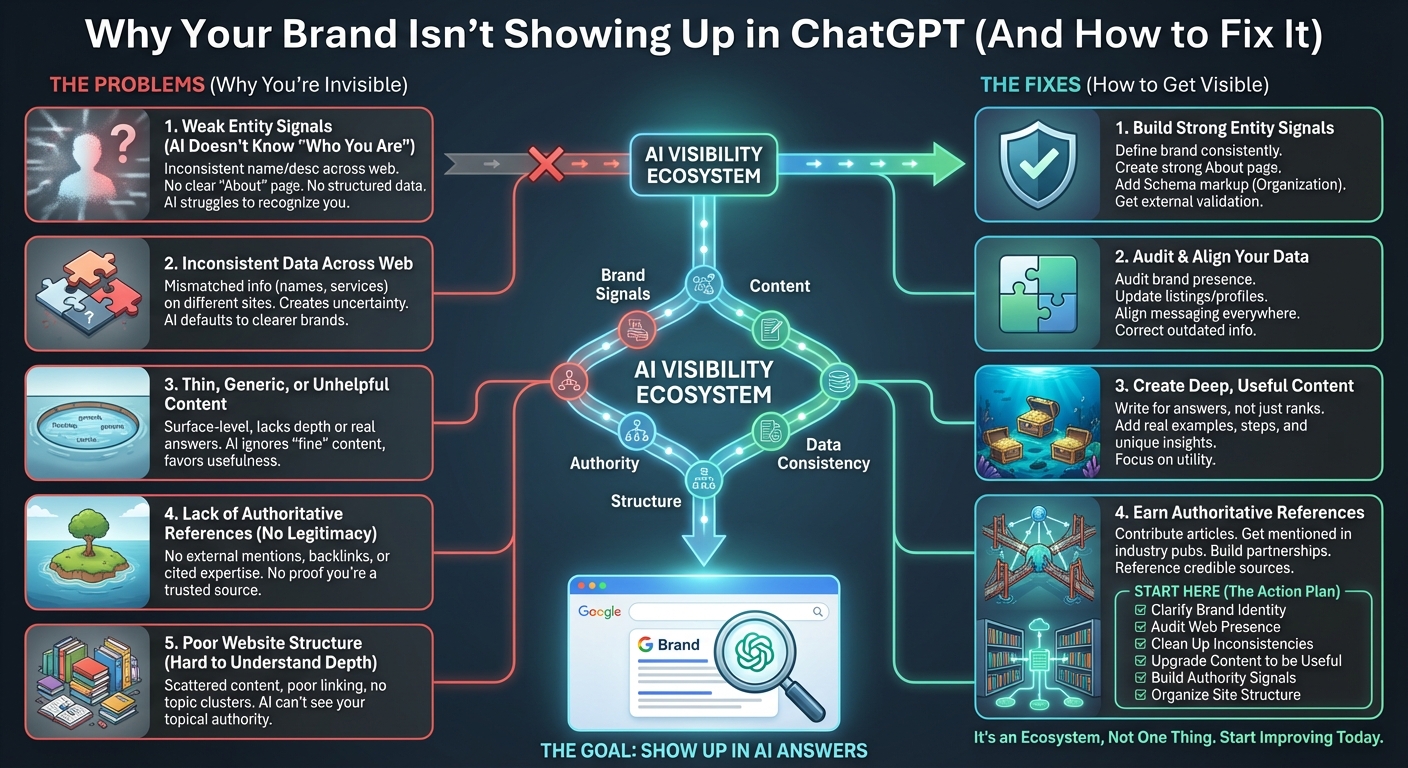
The Big Takeaway: AI Visibility Is an Ecosystem Problem, Not a Website Problem
This is where most people get it wrong.
They treat AI visibility like a content problem.
Or a technical SEO problem.
Or a backlink problem.
But it’s not just one thing.
It’s everything.
Your brand signals, your content, your authority, your structure, your data consistency. They all work together.
And if one piece is weak, it affects the whole system.
I recently had a client with great content. Really solid stuff. But they had almost no external mentions.
Once we started building those signals, their visibility in AI responses changed within a few weeks.
Not overnight. But noticeably.
That’s the shift.
Want to Improve Your AI Search Presence? Start Here
If you’re feeling a little overwhelmed, that’s fair.
This isn’t as simple as tweaking a title tag or adding a few keywords.
But you don’t need to fix everything at once.
Start here:
- Clarify your brand
Make sure AI can clearly understand who you are and what you do - Audit your presence across the web
Clean up inconsistencies - Upgrade your content
Focus on usefulness, not just optimization - Build authority signals
Get mentioned outside your own site - Organize your content
Make it easy to understand and navigate
That’s it.
Simple, but not easy.
And if you’re curious… try something.
Go open ChatGPT and ask a question related to your industry.
See who shows up.
Then ask yourself, honestly, “Why them and not us?”
That question alone will tell you a lot.
If you want help figuring that out, that’s where a team like Enilon can step in. But even if you tackle this on your own, you’re already ahead of most brands just by paying attention to it.
And that matters more than you think.
If you end up testing this and notice changes, I’d actually love to hear about it. Seriously. This space is evolving fast, and real-world feedback is where the best insights come from.
So what are you seeing?
If you’re ready to actually show up where your buyers are searching, reach out to Enilon, and let’s figure out what’s holding your AI visibility back.
FAQ
Why isn’t my brand showing up in ChatGPT results?
Your brand may not appear because AI systems lack enough clear, consistent signals about who you are, what you do, and why you’re credible compared to other sources.
How does ChatGPT decide which brands to mention?
ChatGPT uses patterns from training data and trusted sources. It favors brands that are consistently mentioned, clearly defined, and associated with specific topics across the web.
What improves AI search visibility the fastest?
The fastest improvements come from clarifying your brand positioning, publishing direct answer-style content, and earning mentions on reputable external websites.
Does traditional SEO help with AI visibility?
Yes, but it’s not enough on its own. SEO helps with discoverability, but AI visibility also depends on brand recognition, authority signals, and how often your brand is referenced in context.
How can I check if my brand appears in AI search?
Run common industry questions in tools like ChatGPT or Perplexity. Track which brands are mentioned and compare their content, authority, and positioning against yours.

Mark Pysher is an internet professional with 30 years of experience. As an SEO specialist skilled at boosting search rankings through strategic optimization, he blends technical expertise and creative strategies to elevate brands online. Mark lives in the Portland, Maine area and enjoys time with his family, traveling, hiking, and pickleball.
